Field note 01 · Color
Her color is tuned, not painted.
Chameleons shift color by changing the spacing of tiny guanine crystals in their skin, which changes the light it reflects.
Teyssier et al., Nature Communications (2015)
Field note 01 · Color
Chameleons shift color by changing the spacing of tiny guanine crystals in their skin, which changes the light it reflects.
Teyssier et al., Nature Communications (2015)Field note 02 · Eyes
0°nearly all the way round
A chameleon can look two ways at once, and together its eyes see nearly all the way around it.
Florida Museum of Natural History (2025)Field note 03 · Why
She was easy to miss a moment ago, but chameleon color change evolved mainly for signaling to other chameleons, not for camouflage.
Stuart-Fox & Moussalli, PLoS Biology (2008)Live · move your cursor
Iris watches you. Then she eats the fly.
Click her tail or her front foot to see them move. In fly mode, bring the fly up to her mouth: when it opens, click, or hold still and she takes it herself. In the smallest chameleons, the tongue goes 0 to 60 mph in a hundredth of a second.
Tap her tail or her front foot. In fly mode, tap anywhere to let a fly go.
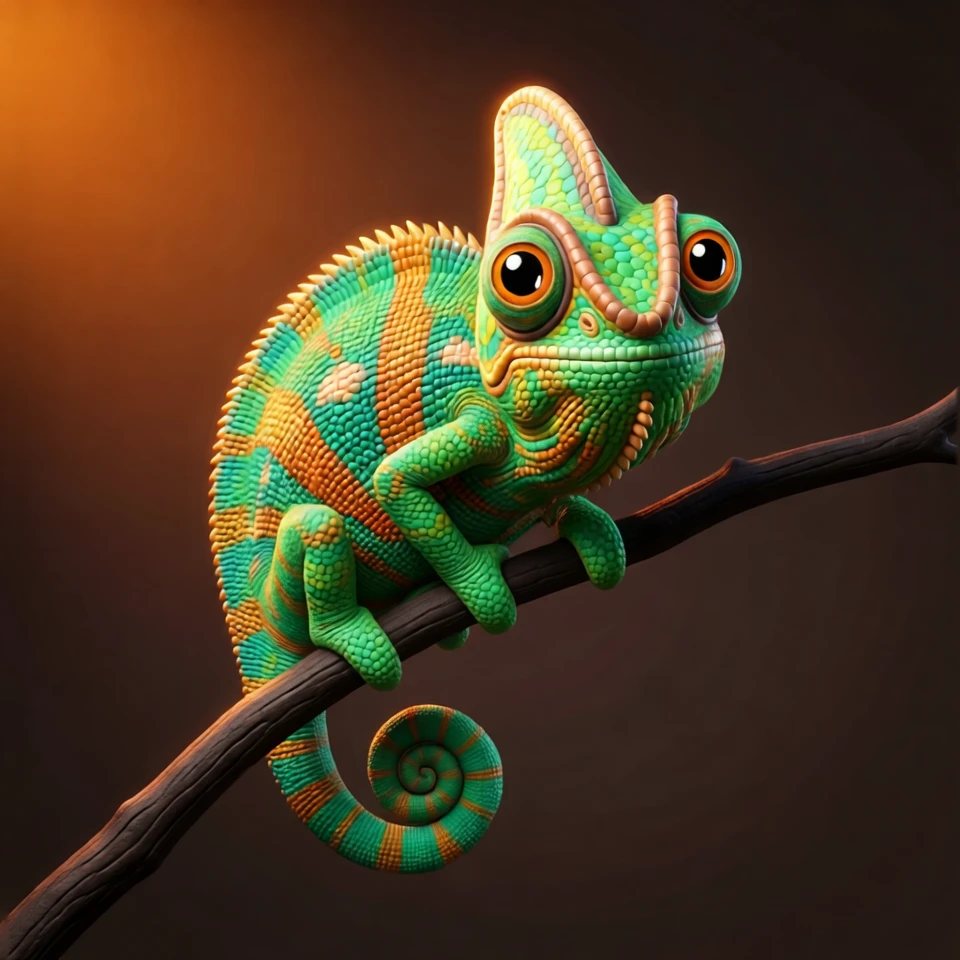
A chameleon who watches you back. Move your cursor and she turns her head toward it, both eyes on you, until one of them gets bored.
Iris is a chameleon who watches you back. Move your cursor and she turns her head toward it while both eyes follow, until one of them loses interest and wanders off, because that is what chameleon eyes do. Every so often she uncurls her tail or lifts a front foot off the branch. Turn on fly mode and click: her tongue does the rest.
Behind the picture is a real 3D puppet. Her model was cut free of the branch, her tail rebuilt so it can uncurl, and her head and front foot rigged. That model drives every move, but every pixel you see is her one finished frame, so when she is still she looks exactly like herself.
Production log
Field notes
Chameleons shift color by changing the spacing of tiny guanine crystals in their skin, which changes the light it reflects.
Teyssier et al., Nature Communications (2015) →A chameleon can look two ways at once, and together its eyes see nearly all the way around it.
Florida Museum of Natural History (2025) →She was easy to miss a moment ago, but chameleon color change evolved mainly for signaling to other chameleons, not for camouflage.
Stuart-Fox & Moussalli, PLoS Biology (2008) →In the smallest chameleons, the tongue goes 0 to 60 mph in a hundredth of a second.
Anderson, Scientific Reports (2016), via Brown University →